

As digital access nears saturation across major BRICS economies, the grouping is turning its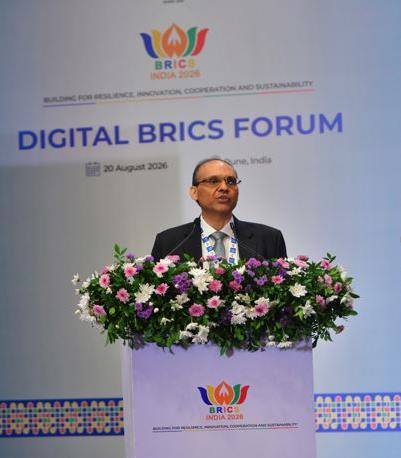 attention to a harder challenge: building digital systems citizens can trust. India’s message at the Digital BRICS Forum in Pune suggests that cybersecurity, child protection and accountable artificial intelligence could increasingly shape the bloc’s technology agenda.
BRICS’s digital transformation story is entering a new phase. For much of the past decade, success was measured through connectivity: how many people came online, how far broadband networks reached and how quickly mobile infrastructure expanded. That phase has delivered remarkable gains.
Internet connectivity among the five founding BRICS countries has risen from about 45 per cent in 2016 to nearly 82 per cent today, adding around 1.3 billion internet users. During the same period, 4G coverage increased from approximately 84 per cent to almost 99 per cent of their combined population.
But connectivity alone is no longer enough.
At the Digital BRICS Forum in Pune on August 20, India placed safety, trust and protection of vulnerable users at the centre of the emerging digital agenda. Department of Telecommunications Secretary Amit Agrawal’s argument is significant: digital enablement and digital safety cannot be treated sequentially. Security must be built into digital systems from the start, not added after problems emerge.
From Digital Scale to Digital Trust
India’s proposition rests on three pillars: digital public infrastructure that is safe by design; legal obligations on organisations handling personal data or digital content; and accessible mechanisms through which citizens can enforce digital rights and seek grievance redressal.
This represents an important evolution in the BRICS technology conversation.
As artificial intelligence and other frontier technologies increase the reach and power of digital systems, they simultaneously expand vulnerabilities. The next contest in digital governance will therefore not simply concern who can build the largest platforms. It will concern who can build systems that combine scale, innovation, privacy, accountability, and public confidence.
India is positioning its digital public infrastructure as evidence that scale and safeguards need not compete.
Aadhaar illustrates this approach by separating identity authentication from service delivery. The system restricts the information required for enrolment and does not disclose biometrics to service providers. India now has approximately 1.4 billion Aadhaar holders who have undertaken more than 170 billion authentications. Aadhaar has also helped create a digital pipeline connecting more than a billion identities, mobile connections and bank accounts.
UPI extends the principle to payments. According to the address, India now accounts for nearly half of global real-time payments each month. The architecture limits the sharing of bank details between parties, while the reported incidence of fraud stands at only 0.02 per million transactions.
The broader message is clear: trust is becoming infrastructure in its own right.
Regulation Moves to the Centre
The second element is regulation.
India presented its Information Technology Act and Digital Personal Data Protection Act as examples of principle-based regulation that can adapt to technological change. Under the IT framework, intermediary protections are linked to due-diligence responsibilities regarding harmful or unlawful content. Larger social-media intermediaries also face additional obligations involving automated detection and public reporting.
The emerging challenge posed by generative AI is also entering this regulatory architecture. Social-media platforms must label synthetically generated information and preserve those labels when content is shared. Child protection receives particular emphasis: the Digital Personal Data Protection framework prohibits processing children’s data without verifiable parental consent and restricts behavioural monitoring and targeted advertising involving children.
This is potentially important for BRICS cooperation. With different political systems, legal traditions and levels of digital maturity, agreement on a single regulatory model may be difficult. Yet common principles — safety by design, protection of children, transparency around AI-generated content and effective grievance mechanisms — could provide workable areas for convergence.
Can BRICS Shape Global Digital Rules?
The strongest argument for deeper cooperation is scale.
BRICS countries collectively account for around half of the world’s population, roughly two-fifths of global GDP and about three-fifths of ICT specialists. They also host a substantial share of digital public infrastructure and include two of the world’s five leading countries in AI inventions.
That gives the grouping more than economic weight. It gives BRICS the potential to become a major laboratory for digital governance.
Until recently, global technology debates were frequently framed around innovation, connectivity and platform growth. The emerging BRICS discourse adds another layer: how countries can preserve innovation while establishing trustworthy digital environments at population scale.
The significance of the Pune discussion therefore lies beyond cybersecurity alone. It signals a possible transition from a BRICS connectivity agenda to a BRICS trust agenda.
The next decade will test whether the grouping can convert its enormous digital scale and diversity into shared standards, interoperable safeguards and practical models for responsible technology governance.
If it succeeds, BRICS may not merely participate in the global digital transformation. It could increasingly help determine the rules governing that transformation.
