
IFFI 2026: Beyond the Silver Screen, India’s Emerging Global Creative Ambitions
As the 57th International Film Festival of India concludes in Goa, its celebration of cinematic diversity, emerging talent and international collaboration signals India's growing ambitions in the global creative economy.

Goa, 29 November 2026: The curtains have fallen, but the conversations continue. The 57th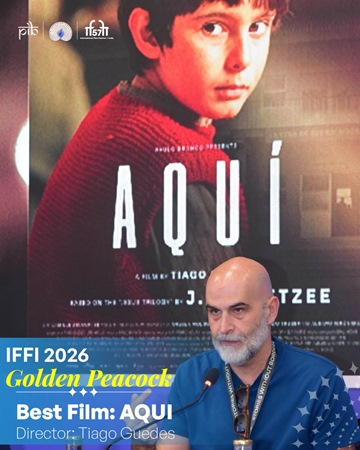 International Film Festival of India (IFFI), which concluded in Goa on Saturday, offered more than a celebration of cinematic excellence. It presented an evolving vision of India as a global destination for storytelling, creative entrepreneurship, cultural diplomacy and international film production.
Over nine days, from November 20 to 28, the festival showcased more than 150 international films from 86 countries, alongside 76 Indian Panorama films across 18 languages. Under the theme Stories Without Borders, IFFI brought together established filmmakers, emerging artists, producers, investors and audiences, reinforcing cinema’s ability to transcend geographical and cultural boundaries.
The festival’s significance, however, increasingly lies at the intersection of artistic expression, economic opportunity and cultural influence.
Celebrating Excellence Across Cinematic Traditions
The French-Portuguese co-production Aquí, directed by Tiago Guedes, secured the Golden Peacock for Best Film, emerging victorious among 15 international competition entries.
German filmmaker Volker Schlöndorff received the Silver Peacock for Best Director for Visitation, while Maya O’Rourke won Best Actor (Female) for The Meltdown.
Indian cinema registered a significant achievement with Rishab Shetty winning Best Actor (Male) for the Kannada film Kantara: A Legend – Chapter 1. The film also received a Special Mention from the International Jury.
Argentina’s The River Train, directed by Lorenzo Ferro and Lucas A. Vignale, received the Special Jury Award for its experimental storytelling. Bérenger Thouin won the international debut feature award for The Golden Age, while Dr Vishal Chaturvedi received the Indian debut director award for Hanuman Ansh.
The Turkish film Rahma, directed by Faysal Soysal, secured the ICFT-UNESCO Gandhi Medal.
The diversity of the winning films underscores an important cinematic reality: stories deeply rooted in particular cultures can resonate universally. International recognition need not require filmmakers to dilute their cultural identities or conform to conventional commercial narratives.
From Festival Destination to Creative Industry Hub
Goa’s ambitions extend beyond its established identity as India’s premier film festival destination.
Addressing the closing ceremony, Chief Minister Dr Pramod Sawant articulated a broader vision of developing Goa into an international film production and creative industry hub. His call, “Make in Goa, Make for the World,” reflects an aspiration to convert the state’s cultural visibility into sustainable economic opportunities.
After 22 years of hosting IFFI, Goa has an opportunity to develop a year-round creative ecosystem encompassing production infrastructure, post-production services, filmmaking education and digital content development.
Such an ecosystem could generate skilled employment, attract international productions and diversify the state’s tourism-dependent economy.
Equally important is developing Konkani cinema. A globally connected film destination must also nurture its indigenous creative talent, linguistic heritage and local storytelling traditions.
The Business Behind the Stories
One of the festival’s most consequential developments was the growing international engagement through WAVES Film Bazaar.
Its 20th edition attracted 2,288 delegates from 54 countries, including 471 buyers. These figures highlight the importance of connecting independent filmmakers with financiers, distributors, streaming platforms and potential co-production partners.
For India’s independent and regional filmmakers, access to international distribution remains a significant challenge. Producing quality cinema is only one part of the journey; securing financing, marketing films and reaching audiences across territories are equally critical.
Film Bazaar can help bridge these gaps by creating opportunities for collaboration and commercial partnerships.
Its long-term success must, however, be assessed through completed co-productions, distribution agreements, investments and international market access rather than participation figures alone.
Investing in the Next Generation
IFFI’s emphasis on emerging talent reflects another important dimension of India’s creative ambitions.
The Creative Minds of Tomorrow initiative brought together 100 young participants representing 13 filmmaking disciplines. The newly introduced Page Se Pitch Tak programme created opportunities for aspiring screenwriters.
Recognising Made in India: A Titan Story as the Best Web Series also acknowledged the growing significance of digital storytelling.
These developments reflect a changing entertainment landscape where conventional cinema increasingly coexists with streaming platforms and diverse storytelling formats.
India’s creative economy requires sustained investment in screenwriting, technical expertise, intellectual property development and creative entrepreneurship. Democratising access to these opportunities, particularly for young talent from smaller towns, could unlock a new generation of storytellers.
Cinema as an Instrument of Cultural Diplomacy
With Spain as Country of Honour, Russia as Partner Country and a dedicated BRICS showcase, IFFI also demonstrated cinema’s potential as an instrument of cultural diplomacy.
Unlike conventional diplomatic engagements, cinema enables societies to understand one another through everyday experiences, historical memories, emotions and shared human aspirations.
For India, with its extraordinary linguistic and cultural diversity, this represents a substantial soft-power opportunity. Regional cinema, in particular, could become an increasingly influential vehicle for India’s international cultural engagement.
The 57th IFFI has reaffirmed India’s capacity to convene the global cinematic community. The next challenge is to translate this convening power into enduring creative partnerships, commercial opportunities and international recognition.
Ultimately, India’s cinematic ambitions will be realised not merely by hosting the world’s stories, but by enabling its own stories to travel the world.
