

Goa, November 28, 2026: Cinema remains a powerful medium of human connection. Beyond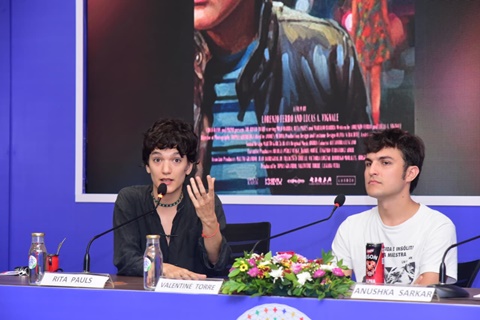 technological innovations, commercial imperatives and the growing dominance of streaming platforms, its enduring strength lies in telling stories that transcend geographical and cultural boundaries.
Two films showcased at the 57th International Film Festival of India (IFFI) in Goa — Argentina’s The River Train (El Tren Fluvial) and Portugal’s Come With Me (Anda daí) — offer compelling perspectives on this enduring relevance.
While the Argentine feature explores childhood, freedom and the pursuit of dreams, the Portuguese film examines friendship, human relationships and the importance of shared cultural experiences. Together, they illuminate the creative possibilities of independent cinema and its capacity to discover universality in culturally specific stories.
Childhood Beyond Conventional Boundaries
Directed by Lorenzo Ferro and Lucas A. Vignale, the 75-minute Spanish-language feature The River Train premiered in IFFI’s International Competition section.
Set against the expansive landscape of the Argentine Pampas, the film follows nine-year-old Milo, who trains in Malambo, a traditional Argentine folk dance. He dreams of travelling by train to Buenos Aires, a city he has experienced only through cinema.
His journey becomes an exploration of personal freedom, curiosity and the tension between individual aspirations and societal expectations.
Beyond its narrative, however, the film offers an equally fascinating story of collaborative filmmaking.
Addressing a press conference on Friday, producer Valentine Torre recalled how an informal invitation among friends evolved into a feature that subsequently travelled to international film festivals in Berlin, San Sebastián and Buenos Aires.
The production challenges conventional filmmaking practices, particularly in how it engages with children. Milo Barría, a young Malambo dancer without previous acting experience, became central to the creative process.
Actor Rita Pauls, who plays the Professor, explained that rather than imposing the conventional discipline of a film set on the child, the entire crew adapted its working methods to his emotional needs, moods and rhythms.
This approach offers an important insight into filmmaking: authenticity sometimes emerges not from rigid directorial control but from sensitivity, patience and creative flexibility.
The film’s 4:3 aspect ratio and partial use of black-and-white imagery reflect both artistic preferences and financial constraints. They demonstrate how independent filmmakers can transform production limitations into distinctive cinematic expressions.
Friendship in an Increasingly Fragmented World
Portugal’s Come With Me, which had its world premiere in IFFI’s Cinema of the World section, approaches human connections from another perspective.
Directed by João Lameira, the film explores male friendship within Lisbon’s cultural landscape. Its geographical specificity, however, does not diminish its universal appeal.
“I hope the story and the characters are universal enough to be understood by everyone,” Lameira said during the press conference.
His observation touches upon a fundamental principle of world cinema: stories deeply rooted in local cultures can resonate across continents when they address shared human experiences.
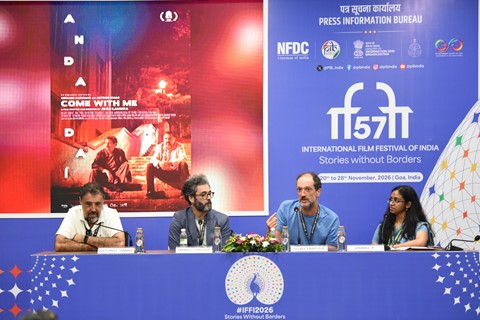 Actor António Simão brought another dimension to the discussion, expressing concern over declining cinema audiences in Portugal and the growing preference for watching films at home.
“People need to be together and talk and see each other,” he remarked, concluding with an emphatic appeal: “Long live cinema.”
His remarks extend beyond the commercial challenges confronting theatrical exhibition. They raise larger questions about social interaction, cultural participation and the gradual individualisation of entertainment.
The Changing Economics of Cinema
The proliferation of streaming platforms has democratised access to international cinema, enabling audiences to discover films that might otherwise remain geographically inaccessible.
Yet this transformation also presents challenges for independent filmmakers, theatrical distributors and traditional exhibition networks.
Producer Daniel Pereira argued that streaming services should complement, not replace, theatrical exhibition. His company’s continued emphasis on cinema releases reflects a commitment to preserving cinema as a collective cultural experience.
The discussion also challenged the increasingly restrictive distinction between art-house and mainstream cinema.
Lameira maintained that he approached filmmaking without subscribing to either classification. Pereira observed that films with distinctive directorial perspectives and compelling narratives were once more accessible to wider audiences.
Their observations invite reflection on whether contemporary distribution and marketing practices have narrowed the space available for artistically ambitious cinema.
IFFI as a Bridge Between Cultures
The presence of Argentine and Portuguese cinema in Goa reinforces IFFI’s significance as a platform for cultural exchange, creative partnerships and international cinematic discovery.
For the Portuguese delegation, Goa’s historical and architectural connections with Portugal added another layer of cultural engagement. Meanwhile, Torre expressed interest in exploring future filmmaking collaborations in India.
These exchanges show how international film festivals can build relationships beyond screenings, creating opportunities for co-productions, artistic experimentation, and knowledge-sharing.
Ultimately, both films reaffirm a fundamental truth: cinema thrives when it remains connected to human experiences. In an age increasingly shaped by algorithms, individualised consumption and commercial calculations, their celebration of childhood, friendship, freedom and collective creativity offers a timely reminder of cinema’s deeper cultural purpose.
