
India-UAE Ties Gain Momentum: Piyush Goyal’s UAE Visit Signals Deeper Economic Synergies
The visit, focused on bilateral discussions, aligns with India’s push to advance its 'Viksit Bharat' (Developed India) vision, while the UAE aims to establish itself as a global hub for economic diversification beyond oil.

In a pivotal moment for Indo-UAE relations, India’s Minister of Commerce and Industry, Piyush Goyal,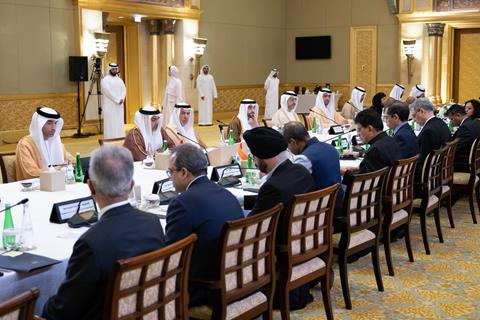 embarked on a high-stakes visit to the United Arab Emirates, underscoring the burgeoning economic partnership between the two nations. Amid global uncertainties, this engagement highlights how emerging economies are forging resilient alliances, with trade and investment at the core. The visit, centered on bilateral dialogues, comes at a time when India seeks to accelerate its ‘Viksit Bharat’ (Developed India) vision. At the same time, the UAE positions itself as a global hub for diversification beyond oil.
Co-chairing the UAE-India Business Council (UIBC) Roundtable alongside the UAE’s Minister of Foreign Trade, Dr Thani bin Ahmed Al Zeyoudi, Goyal engaged with top CEOs from both countries. The discussions radiated optimism, celebrating the “ever-growing” economic ties. Key highlights included strategies to boost trade flows, fortify business partnerships, and unearth new collaborative frontiers. Notably, progress on flagship projects, such as Bharat Mart—a massive warehousing facility in Dubai aimed at easing Indian exports—and the India-UAE Friendship Hospital, was reviewed. These initiatives are poised not only to amplify bilateral trade but also to uplift the Indian diaspora in the UAE, which numbers over 3.5 million and serves as a vital bridge between the nations.
The roundtable transcended mere economics, delving into the realm of philanthropy. Both ministers commended the roles of business leaders in community initiatives, signalling a holistic partnership approach. Notably, they encouraged companies to expand their ambitions beyond bilateral borders, targeting regions such as Africa, Europe, and Central Asia. This outward-looking strategy could transform India and the UAE into gateways for mutual market access, leveraging India’s manufacturing prowess and the UAE’s logistical edge.
A separate session, orchestrated by Nilesh Ved, Chairman of the Apparel Group, brought Goyal face-to-face with the UAE’s business elite. Here, the focus sharpened on investment outreach. Goyal painted a vivid picture of India’s economic resurgence, characterised by robust macroeconomic growth, significant infrastructure improvements, and inclusive social policies. He spotlighted the 7.8% GDP surge in Q1 of FY 2025-26, with inflation in check, positioning India as a beacon for global investors amid slowdowns elsewhere. This narrative isn’t just rhetoric; it reflects India’s reform trajectory, from eased FDI norms to digital advancements, making it an attractive counterweight to China’s dominance.
UAE investors, however, provided candid feedback on hurdles such as market access, regulatory bottlenecks, and dispute resolution. Arbitration frameworks and enforcement predictability emerged as pain points. Goyal responded affirmatively, reaffirming India’s commitment to a “transparent and facilitative” ecosystem. This dialogue is crucial in an era where investor confidence hinges on predictability. Analysts note that addressing these issues could unlock billions in UAE investments, especially in sectors such as renewable energy and technology, building on the 2022 Comprehensive Economic Partnership Agreement (CEPA) that slashed tariffs and spurred a 20% increase in trade to over $85 billion annually.
Targeted meetings amplified the visit’s impact. Goyal’s discussions with Hana Al Rostamani of First Abu Dhabi Bank explored potential financial synergies, which could ease capital flows for Indian projects. Interactions with Irfan Allana of the IFFCO Group and Sharafuddin Sharaf of the Sharaf Group focused on expanding their footprints in India, from agribusiness to logistics. These one-on-ones underscore a shift from broad agreements to actionable corporate tie-ups.
Engagement with the Indian diaspora via the India People’s Forum added a human dimension. Goyal lauded their contributions, which extend beyond remittances to innovation and cultural exchange. The diaspora, often referred to as the “soft power” arm of Indo-UAE ties, has been instrumental in sectors such as IT and healthcare.
Strategically, the UAE remains India’s third-largest trading partner and a linchpin in energy security, supplying 7% of its crude oil. The comprehensive partnership spans defense, technology, and food security, fortified by high-level visits like Prime Minister Modi’s frequent UAE trips. Yet, challenges loom, geopolitical tensions in the Middle East could disrupt supply chains, and competition from other Gulf nations demands agility.
Goyal’s visit isn’t isolated; it’s part of a continuum of momentum following CEPA. By fostering trust and addressing frictions, it paves the way for a $100 billion trade target by 2030. In a multipolar world, this alliance exemplifies how strategic partners can co-create prosperity, striking a balance between ambition and pragmatism. As both nations eye global leadership, the real test lies in translating dialogues into deliverables—watch for accelerated project timelines and investment inflows in the coming months.
