

On September 20, 2025, Prime Minister Narendra Modi launched a transformative chapter for India’s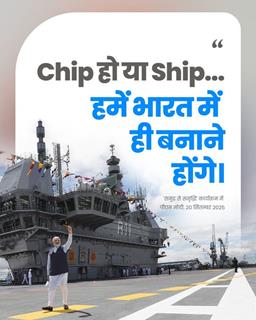 maritime sector, inaugurating and laying the foundation for projects worth over ₹34,200 crore in Bhavnagar, Gujarat, during the ‘Samudra se Samriddhi’ event. This ambitious initiative, coupled with his clarion call for self-reliance, signals India’s intent to reclaim its historical maritime prowess and position its coastlines as gateways to national prosperity. In a world grappling with economic uncertainties, Modi’s vision underscores how strategic investments in infrastructure and policy reforms can redefine India’s role in global trade.
Addressing a vibrant crowd, Modi emphasised that self-reliance, or Atmanirbhar Bharat, is non-negotiable for a developed India by 2047. “Chips or ships, we must make them in India,” he declared, framing dependency on foreign nations as the country’s greatest adversary. This rhetoric isn’t mere nationalism; it’s rooted in stark economic realities. Modi revealed that India spends approximately $75 billion annually—equivalent to its defense budget—on foreign shipping services. Over the decades, this outflow has fueled job opportunities abroad while stifling India’s shipbuilding ecosystem. Historically a maritime powerhouse, India’s share in its own trade plummeted from 40% in the 1970s to a mere 5% today, with 95% of its trade reliant on foreign vessels. This dependency, Modi argued, undermines national self-respect and economic sovereignty.
The Prime Minister attributed this decline to post-independence policies mired in a license-quota regime and a myopic focus on imports, which he claimed led to scams and stunted India’s potential. The shipping sector, once a global leader, was particularly hard-hit. Modi criticised past governments for neglecting domestic shipbuilding, allowing foreign vessels to dominate India’s trade routes. His administration, however, is reversing this trend through sweeping reforms. A landmark decision announced during the event grants infrastructure status to large ships, unlocking easier loans, lower interest rates, and financial incentives for shipbuilding companies. This move, coupled with over ₹70,000 crore in planned investments, aims to modernise shipyards, enhance design standards, and boost competitiveness in global markets.
The projects unveiled in Bhavnagar reflect this ambition. From the Mumbai International Cruise Terminal to new container berths in Kolkata and Paradip, and a Green Bio-Methanol Plant in Kandla, these initiatives prioritise port-led development. Gujarat, handling 40% of India’s sea cargo, is at the forefront. The Alang Ship Breaking Yard, a global leader in ship recycling, is generating significant employment. At the same time, the upcoming Vadhavan Port in Maharashtra, costing over ₹75,000 crore, aims to rank among the world’s top ten ports. These developments align with the Sagarmala initiative, which has doubled port capacity since 2014 and slashed ship turnaround times from two days to under one.
Modi’s vision extends beyond infrastructure. He highlighted the multiplier effect of shipbuilding, dubbed the “Mother of All Industries,” which spurs growth in steel, electronics, textiles, and MSMEs. Every rupee invested in shipbuilding yields nearly double in economic returns, and each shipyard job creates six to seven more in the supply chain. To support this, Industrial Training Institutes and the Maritime University will bolster skill development, while the Navy and NCC are expanding training for commercial maritime roles. India’s seafarer count has surged from 1.25 lakh to over three lakh in a decade, positioning it among the top three global suppliers.
The event also showcased Gujarat’s broader development. Projects worth ₹26,354 crore, spanning renewable energy, healthcare, and highways, underscore a holistic growth approach. The HPLNG Regasification Terminal at Chhara Port and the complete solarisation of Dhordo village highlight sustainable industrialisation. The Dholera Special Investment Region, which Modi will survey from the air, envisions a greenfield industrial city, while the National Maritime Heritage Complex at Lothal, costing ₹4,500 crore, will celebrate India’s ancient maritime legacy, rivalling the Statue of Unity as a cultural beacon.
Modi’s address wasn’t just about economics; it carried a cultural and emotional resonance. Paying tribute to Krishnakumarsinh Ji for his role in India’s unity, he linked the event to the broader mission of Ek Bharat, Shreshtha Bharat. With Navratri approaching, he noted GST reductions would boost festive markets, tying economic reforms to cultural vibrancy. His call for “Swadeshi” purchases—urging shopkeepers to display “Say with pride, this is Swadeshi” posters—aims to foster a consumer movement for indigenous goods.
Yet, challenges persist. Scaling shipbuilding requires overcoming global competition, technological gaps, and supply chain disruptions, particularly amid heightened tensions in the Middle East. Critics argue that while reforms are bold, execution timelines and private sector participation remain critical. The opposition may seize on Modi’s critique of past policies to highlight current gaps in skill development or MSME financing. Nevertheless, the numbers speak: India’s port capacity is doubling, seafarer growth is increasing, and its share in global maritime trade is rising to 10%. This signals momentum. Modi’s pledge to triple this share by 2047 is ambitious but grounded in tangible reforms, such as ‘One Nation, One Document’ and updated maritime laws.
In a multipolar world, India’s maritime push serves as a strategic counter to its overreliance on global supply chains. By reviving its shipbuilding legacy and leveraging Gujarat’s coastal strengths, Modi’s government is betting on self-reliance to drive prosperity. The ‘Samudra se Samriddhi’ event isn’t just a milestone; it’s a blueprint for an India that builds its own ships, powers its own ports, and charts its own destiny.
