

New Delhi, October 17, 2025 — A solemn anniversary carried a wider message. The Embassy of Israel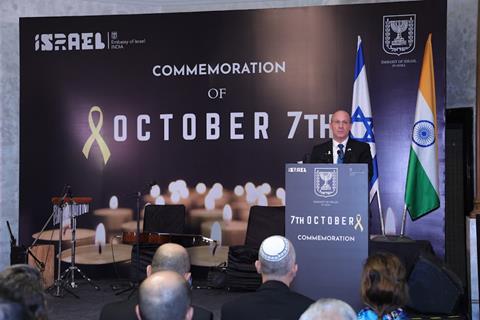 in India commemorated two years since the 7 October terror attacks with a dignified ceremony in New Delhi that blended remembrance, testimony, and strategic reflection. The evening honoured lives lost and scarred, but it also asked a harder question: what will it take for democracies to prevent the next tragedy while still holding fast to human dignity?
The Guest of Honour, Lt Gen (retd) Vinod Khandare—former Principal Advisor to India’s Ministry of Defence and a one-time Deputy National Security Advisor—set the tone. A veteran of counter-insurgency and intelligence operations, he linked India’s own experience of mass-casualty terrorism to Israel’s ordeal. Recalling the horror of 26/11 in Mumbai, he argued that the kinship between the two countries is forged not only by shared interests but by shared wounds. His core claim was blunt and unsentimental: national resilience is a civic duty, and international cooperation against terror must be constant, not episodic. He praised Israel’s “national resilience” and “the contribution of every citizen,” while asking why global outrage too often fades when civilians, not soldiers, become targets. The line that stayed with the room was his assertion that the “existential threat is something which is common to India and Israel,” and therefore strength and vigilance are not optional—they are survival tools.
If Khandare framed the security logic, Avihay Brodutch supplied the human truth. A resident of Kibbutz Kfar Aza, he survived the 7 October assault even as his wife, Hagar, and their children—Ofri, Yuval, and Oriya—were abducted to Gaza. His simple handwritten sign— “My family is in Gaza”—became a global emblem during the hostage campaign that followed. His testimony in New Delhi was unsparing. He described gunmen “flying over the kibbutz” and friends killed beside him. He recalled his family’s release after 51 days: starving, infested with lice, with marks on their bodies. Yet he chose to address the audience with a message that cut against the grain of vengeance: “You should concentrate on healing.” Peace, he suggested, begins with repair—within Israel, and between Israel and its neighbours. It was less a political argument than a moral instruction born of direct harm.
Ambassador Reuven Azar anchored the evening in statecraft. He called 7 October “a brutal terrorist massacre” that aimed not only to kill but to declare to Israelis that they had no future in their homeland. His diagnosis of the causes placed responsibility squarely on Hamas and its long preparation, and he thanked Prime Minister Narendra Modi, the Government of India, and the Indian people for their solidarity. That gratitude was not mere diplomatic courtesy. It signalled how Israel reads India’s stance on terrorism: principled, consistent, and conditioned by India’s own painful history of attacks that target the innocent to wound the nation.
Cultural expression lent the ceremony its closing cadence. The Israeli ensemble Trio4 performed “Keshetavo,” “Halev Sheli,” and “Shir LaMa’alot.” The set list tracked a quiet arc—from longing, through grief, toward uplift. Music does not fix policy, but it can steady a society’s spirit, and the group’s India tour underscores a deeper point: people-to-people ties matter when headlines fray. Cultural diplomacy widens the aperture through which nations see one another, carrying memory without hardening it into permanent mistrust.
What, then, is the significance of this commemoration in New Delhi? First, it reminds us that anniversaries are not only about the past; they are about the choices we make next. For India and Israel, the strategic agenda is both familiar and urgent: intelligence cooperation, counter-radicalisation, cyber defence, border protection, and defence technology partnerships that can shorten decision loops and improve deterrence. These ties do not exist in a vacuum. They sit within broader convergences—in maritime security, innovation ecosystems, and critical technologies—that give the security pillar durability.
Second, the event placed civilians—victims and hostages—at the centre of the narrative. That shift matters. Counter-terrorism fails when it forgets who it is meant to protect. Brodutch’s story made that clarity unavoidable. It also carried an implicit challenge to the international community: consistency. Outrage at crimes against civilians cannot be selective, and the language of human rights cannot fall silent when terror’s targets are inconvenient to prevailing narratives. Khandare’s critique—that the world’s voice was too soft—will resonate in both capitals.
Third, the ceremony highlighted a paradox democracy must manage: a relentless pursuit of security alongside a refusal to surrender the possibility of reconciliation. Azar’s statement on solidarity and Brodutch’s plea for “healing” are not contradictions. They are the twin rails on which any durable peace must run justice that halts perpetrators and a social ethic that refuses to define the future by the worst acts of the past.
Finally, there was a quieter diplomatic message. By choosing to mark the anniversary in India with senior Indian participation, Israel acknowledged not just a partner but a peer—another large, plural democracy navigating the 21st century’s asymmetric threats. India’s presence signalled that remembrance, too, can be a form of strategic communication: a way to align values, cement partnerships, and keep focus on the civilian at the heart of national security.
As the evening closed, the audience held two truths at once. The first is unyielding memory—of lives cut short, families broken, and communities changed forever on 7 October. The second is a stubborn hope—for the safe return of all remaining hostages, for dignity in mourning, and for a politics that privileges life over spectacle. Between those truths lies the work of statesmen, soldiers, and citizens. It is the work that India and Israel, in different ways and for shared reasons, have pledged to continue.
