

New Delhi, November 28, 2026: The Indian Ocean is emerging as a defining theatre of twenty-first-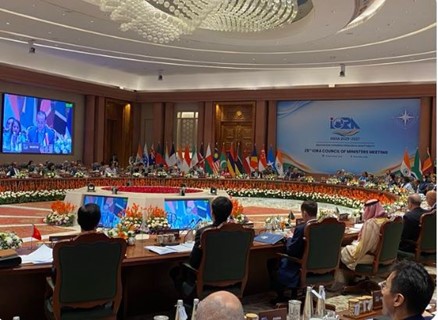 century geopolitics. India is seeking to shape its future.
Prime Minister Narendra Modi’s meeting with Foreign Ministers and Heads of Delegation from the 23 member states of the Indian Ocean Rim Association (IORA) on Friday signals New Delhi’s renewed commitment to maritime multilateralism and regional cooperation.
The meeting, held alongside the 25th IORA Council of Ministers, is particularly significant as India holds the chairship of the association for 2025–2027.
Reaffirming India’s commitment to regional partnerships, Modi highlighted the centuries-old civilisational, commercial and cultural connections fostered by the Indian Ocean. He emphasised advancing India’s vision of MAHASAGAR — Mutual and Holistic Advancement for Security and Growth Across Regions — to strengthen regional stability, security and prosperity.
From SAGAR to MAHASAGAR
The MAHASAGAR doctrine represents an evolution of India’s maritime and strategic thinking. Building on the earlier SAGAR framework — Security and Growth for All in the Region — it reflects a broader understanding of maritime cooperation beyond India’s immediate neighbourhood.
The expanded vision seeks to integrate maritime security, economic development, technological collaboration, climate resilience and capacity-building into a comprehensive framework of regional engagement.
External Affairs Minister S. Jaishankar, addressing the ministerial meeting, underscored the Indian Ocean’s importance to international commerce, energy security, connectivity and economic development, calling for stronger coordination among member countries and dialogue partners.
For New Delhi, the challenge lies in translating this strategic doctrine into tangible institutional partnerships and development outcomes.
The Geopolitical Contest
Stretching from the eastern shores of Africa to Australia, the Indian Ocean connects some of the world’s most consequential economies, energy suppliers and maritime trade routes.
Strategic chokepoints, including the Strait of Hormuz, Bab el-Mandeb and the Strait of Malacca, make the region indispensable to global energy supplies and commercial shipping.
China’s expanding maritime presence, investments in port infrastructure and growing strategic engagement with coastal nations have added another dimension to regional geopolitics. Meanwhile, the United States, European powers, Japan and Australia remain significant stakeholders in the wider Indo-Pacific.
Against this backdrop, IORA offers India a distinctive diplomatic platform. Unlike military alliances or security-oriented groupings, IORA operates through consensus and emphasises development-oriented cooperation.
Its inclusive character allows countries with divergent geopolitical interests to collaborate without necessarily aligning themselves with competing strategic blocs.
Moving Beyond Maritime Security
Established in 1997, IORA brings together 23 member states and 12 dialogue partners across Africa, West Asia, South Asia, Southeast Asia and Oceania.
Its mandate encompasses maritime safety, trade and investment, fisheries management, disaster preparedness, scientific cooperation, tourism, the blue economy and women’s economic empowerment.
India’s chairship theme — Innovation, Openness, Resilience and Adaptability in the Indian Ocean Region — reflects these expanding priorities.
Significantly, the Council of Ministers endorsed India’s proposals to establish two centres of excellence: a Digital Innovation Hub focusing on ocean sciences at the CSIR-National Institute of Oceanography in Goa, and a Centre of Excellence in Maritime Law at Rashtriya Raksha University in Gujarat.
These initiatives could strengthen regional research capabilities, knowledge-sharing and institutional expertise, giving practical expression to India’s maritime vision.
The Blue Economy Opportunity
The Indian Ocean’s economic potential extends well beyond conventional shipping and energy transportation.
Sustainable fisheries, offshore renewable energy, marine biotechnology, coastal tourism, port modernisation and ocean-based industries present significant opportunities for employment, investment and economic diversification.
For smaller island nations, however, rising sea levels, extreme weather events, coastal erosion and declining marine resources pose existential challenges.
India can leverage its scientific expertise, digital capabilities and development partnerships to help address these vulnerabilities.
Closer cooperation between IORA and the Bay of Bengal Initiative for Multi-Sectoral Technical and Economic Cooperation (BIMSTEC) could also strengthen regional connectivity and economic integration, reducing institutional fragmentation.
The Leadership Test
India’s IORA chairship presents both a diplomatic opportunity and a leadership test.
The association’s diverse membership, uneven economic capacities, consensus-based decision-making and limited institutional resources remain significant constraints.
New Delhi must therefore demonstrate that its leadership can deliver measurable outcomes through capacity-building, technology transfers, maritime infrastructure, disaster preparedness and accessible development financing.
It must also accommodate the aspirations of smaller nations while navigating competing geopolitical interests.
Ultimately, MAHASAGAR’s success will depend less on diplomatic declarations than on its ability to deliver collective benefits.
The New Delhi meeting marks an important milestone in India’s maritime diplomacy. Its larger significance, however, lies in whether India can help transform the Indian Ocean from an arena of strategic competition into a region of cooperative security, economic opportunity and shared prosperity.
