
Keralam’s Health Department Rift Exposes a Deeper Governance Crisis
Keralam’s health governance crisis has deepened as Minister K. Muraleedharan accuses senior officials of stalling reforms and probes into KMSCL procurement, including the controversial ₹19.13 lakh Tennis Club membership linked to former IAS officer Rajeev Sadanandan.

A public confrontation between Keralam Health Minister K. Muraleedharan and Health and Family Welfare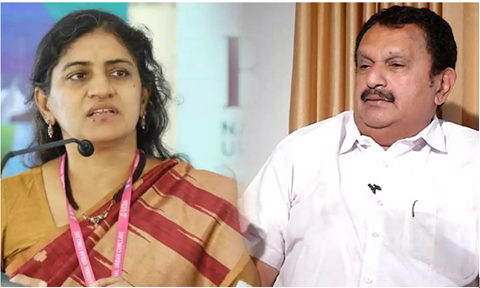 Principal Secretary Sharmila Mary Joseph has turned an internal administrative disagreement into a wider debate about accountability, procurement, and an elected government’s ability to enforce reform in one of the state’s most sensitive departments.
Muraleedharan has asked Chief Minister V.D. Satheesan to remove Sharmila Mary Joseph, alleging that 35 files on which he had directed action were being withheld and that several inquiries he ordered had not progressed. Sharmila has rejected the allegations, saying she does not take political decisions and is only discharging her responsibilities as an official.
That exchange matters because it comes when Keralam’s public health system is already under pressure. Reports of medicine shortages, questions over Kerala Medical Services Corporation Limited (KMSCL) procurement, expired stocks and delayed tenders have brought the functioning of the department under renewed scrutiny.
More than a bureaucratic turf war
At first glance, the dispute may appear to be a familiar minister-versus-bureaucrat confrontation. But its implications are more serious. Ministers determine policy and remain politically accountable to the legislature and the public. Senior civil servants must subject those decisions to law, procedure and financial discipline, and then implement lawful decisions efficiently.
When that relationship breaks down, files become the battleground. Muraleedharan’s allegation that 35 files remain stalled therefore raises a larger question: are legitimate safeguards slowing decisions, or has administrative caution crossed into obstruction?
The distinction is important. A ministerial direction cannot automatically override procurement rules, vigilance procedures or financial controls. Equally, officials cannot indefinitely defer decisions without recording clear reasons. The immediate need is therefore not competing public accusations but a file-by-file administrative audit showing when each direction was issued, what action was required, where the file is pending and why.
Manorama has reported that the disagreements extend beyond investigations to proposals such as master plans for a second medical college and nursing-college hostels, despite institutions offering assistance. The source material supplied for this analysis similarly describes disagreements over hospital infrastructure, engineering capacity and institutional master plans.
KMSCL at the centre of the storm
The most consequential part of the dispute concerns KMSCL, the state agency responsible for procuring and distributing medicines and medical supplies to government hospitals.
The controversy predates the present confrontation. In July, medicines, surgical consumables and PPE reportedly worth around ₹50 crore were found to have expired in KMSCL warehouses, prompting an inquiry.
More recently, Kerala Kaumudi reported a substantial gap between prices KMSCL paid and those paid by the In-House Drug Bank at Thiruvananthapuram Medical College. The newspaper reported that medicines costing KMSCL ₹962 crore could, using its price comparison, have been procured for about ₹772 crore—a difference of ₹190 crore. Muraleedharan subsequently ordered a Vigilance investigation.
The minister has also announced structural changes. KMSCL’s internal quality-control wing has been abolished, and responsibility for testing procured drugs has been transferred to the statutory Drugs Control Department. Muraleedharan has also directed that middlemen be excluded from medicine tenders, procurement prices be published, and future tenders be completed earlier.
These moves suggest that the confrontation is unfolding alongside an attempted redesign of the procurement system, rather than around one file or personality.
Allegations also include delayed inquiries into earlier procurement, unused supplies, and a bleaching-powder tender, as well as resistance to proposals for a dedicated vigilance mechanism. These claims require independent documentary verification, although separate reporting indicates that the proposed KMSCL vigilance mechanism has faced delays.
The Thiruvananthapuram Tennis Club case brings retired IAS officer Rajeev Sadanandan directly into the controversy. Rajeev Sadanandan had served as Additional Chief Secretary in the Health Department and as Managing Director of KMSCL. Manorama reported that KMSCL obtained a 25-year corporate membership in the Thiruvananthapuram Tennis Club in 2017 and incurred about ₹19.13 lakh in membership fees and related expenditure up to 2022. The source material underlying the present controversy alleges that the membership expenditure related to Sadanandan during his association with KMSCL and questions why public funds belonging to a medical-services corporation should have been used for a tennis-club membership.
Muraleedharan ordered the Principal Secretary in July to investigate the expenditure and submit a report within two weeks. According to subsequent reports and the minister’s allegations, the inquiry has not been completed despite repeated directions. The translated source goes further, alleging that resistance to an inquiry into the tennis-club expenditure intensified when the investigation appeared likely to examine decisions associated with Rajeev Sadanandan. That allegation has not been independently established and requires examination of the relevant KMSCL records and official files.
The issue is significant beyond the amount involved. If a public-sector corporation responsible for procuring medicines for government hospitals spent substantial public money on club membership, the government must establish who authorised it, what institutional purpose it served, who benefited, and whether the expenditure complied with financial rules. Equally, any individual named in connection with the allegation, including Rajeev Sadanandan, must have an opportunity to put his version on record.
Medicine shortage raises the stakes
Administrative conflict becomes politically explosive when patients feel its consequences.
Keralam has recently faced disruptions in the availability of essential medicines and surgical supplies. The New Indian Express reported procurement delays, re-tendering, and distribution problems involving KMSCL, with shortages at different stages affecting medicines including antibiotics, paracetamol, and drugs used in cardiac, cancer, and psychiatric care.
The administration has also given conflicting assessments of the seriousness and location of the shortages. That divergence itself points to weaknesses in stock visibility and coordination between KMSCL warehouses, hospitals and senior officials.
The government has since moved to stabilise supplies. District-level monitoring teams are being created to track medicine stocks and distribution. On October 7, Muraleedharan said supplies of major categories of medicines had been streamlined. Hospitals have also been authorised to make local purchases where necessary to prevent treatment disruptions.
That is reassuring, but it does not eliminate the governance question. A system that requires emergency local purchases because the central supply chain falters may protect patients temporarily, but it also signals that forecasting, procurement schedules, and inventory management need repair.
