

India’s dairy story now faces a harder test. The country has already become the world’s largest milk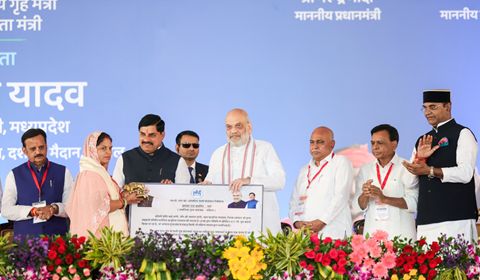 producer. The next challenge is turning that production advantage into higher, more predictable incomes for millions of small livestock rearers.
That ambition was at the centre of Union Home and Cooperation Minister Amit Shah’s address at the Gaupalak Sammelan in Bhopal on October 3. The larger message was clear: India’s next dairy transformation will depend not merely on producing more milk, but on reorganising its collection, processing and marketing through cooperatives.
Under White Revolution 2.0, the government plans to establish 75,000 new multipurpose dairy cooperative societies and strengthen another 46,000 during the five years ending 2028-29. Cooperative milk procurement is expected to rise from about 660 lakh kg per day in 2023-24 to roughly 1,000 lakh kg per day. Achieving this would require annual procurement growth of around nine per cent.
From production to value addition
India enters this phase from a position of considerable strength. Milk production increased from 146.31 million tonnes in 2014-15 to 247.87 million tonnes in 2024-25. Per capita milk availability reached 485 grams per day, considerably above the global average. But annual milk-production growth has slowed to 3.58 per cent in 2024-25.
This makes productivity, processing and value addition increasingly important.
The cooperative model offers one possible route. Farmers selling individually remain vulnerable to local intermediaries, fluctuating demand and weak bargaining power. An effective cooperative can aggregate milk, assure quality, provide chilling facilities and connect producers with organised processors.
More importantly, processing changes the economics of dairying. Milk can become cheese, butter, ghee, curd, ice cream and other higher-value products. Greater value addition can expand margins beyond the farmgate price of raw milk.
The Bhopal announcements reflect this direction. A three-lakh-litres-per-day processing plant will be established in Ujjain at ₹255 crore. A 40,000-litres-per-day product dairy plant and a new state-level central laboratory have also been inaugurated in Bhopal.
Madhya Pradesh itself has set an ambitious goal of raising daily milk procurement from 12 lakh kg to 52 lakh kg. That scale of expansion, however, cannot come from processing plants alone.
The productivity challenge
The real transformation must begin with the animal and the farmer. Breed improvement, vaccination, reliable fodder, veterinary services, artificial insemination and better animal nutrition will determine whether milk yields rise sustainably. The government is consequently linking White Revolution 2.0 with modern breeding technologies and stronger animal-health systems.
The programme also proposes a wider circular economy around cattle.
Scientific dung collection can support biogas, organic fertilisers and nutrient recycling while reducing methane emissions. Five technology-based dung-processing models are being developed. If commercially viable, these could create an additional income stream for livestock-owning households rather than treating dung simply as waste.
This environmental dimension matters. Expanding India’s cattle economy without better waste management, water efficiency and feed systems could deepen pressures on natural resources. White Revolution 2.0 therefore needs to become a productivity revolution rather than simply a numerical expansion of livestock or cooperative societies.
Women must remain at the centre
Its most consequential impact could be social. Dairy farming is deeply integrated into household economies, with women undertaking much of the daily work of feeding, milking and animal care. Yet ownership, cooperative representation and financial decision-making do not always reflect that contribution.
Direct participation of women in dairy cooperatives can change this equation. Payments routed to women members, leadership positions within societies and access to credit can convert unpaid household labour into recognised economic participation.
That is where White Revolution 2.0 could differ from a conventional agricultural programme.
India has already won the production race. Its next dairy revolution must measure success differently: higher farmer incomes, stronger women-led cooperatives, healthier animals, greater processing, lower environmental costs and better access to markets.
The real test will not be how many new cooperative societies are registered. It will be whether those institutions remain viable, transparent and farmer-controlled after the initial government push.
If that happens, India’s position as the world’s largest milk producer can become something more significant — a mechanism for broad-based rural prosperity.
